Showing posts with label trees. Show all posts

Sunday, January 24, 2021

Ash Tree Status from Hearst Papers

There was a sad, but thorough article in this morning's CT Post on the death of all the ash trees in Connecticut.  The Emerald Ash Borer is wiping out most of them, which is causing a lot of damage to our trails, roads, and utility lines, as well as other impacts.  Ash trees were a big component of the Northeast's forests, and a valuable tree for ecology and lumber.


Another dead ash tree from Boehm Pond Trail - 2019

The Shelton Trails Committee has had to spent a lot of volunteer time in the last couple of years clearing trail blow-downs, or fixing damage from dying ash trees.  It's too bad because a really nice tree in our state was wiped out almost overnight.  Many towns, cities, the State, utility companies, and property owners have spent large sums clearing tree damage from this invasive pest.    Hopefully, the control measures that are discussed in the article will help future generations of ash trees recover somewhat. 

The link to the CT Post article by Robert Miller is here, and a copy of the article is below.

Robert Miller: The CT fight against an invasive beetle that’s killed millions of trees

With the battle lost, the federal government is admitting what everybody knew — the emerald ash borer controls the field.

The U.S. Department of Agriculture announced on Dec. 15 that the USDA’s Animal and Plant Health Inspection Service will no longer try to use federal quarantines to control the spread of the invasive and highly destructive beetle.

Because the borer has now pretty much infiltrated all states east of the Mississippi River, killing about 35 million ash trees from Louisiana to New England along the way, the decision was expected.

“It doesn’t make sense to continue,” said Claire Rutledge, an associate agricultural scientist in the entomology department of the Connecticut Agricultural Experiment Station.

However, now the borer is here, new local fights against it are beginning using biological controls.

Rutledge and other entomologist’s are releasing three species of tiny parasitic wasps that feed on and destroy the borers’ eggs. The hope is that in a decade or two, when ash trees start to grow back, the wasps will have lowered the beetle’s numbers enough to let new ash trees survive.

Rutledge said there are 18 sites in the state where the agricultural experiment station has released the wasps, including places in Sherman, Kent, Weston and Litchfield. The wasps are wintering over and spreading. Initial research shows they’re also doing their work to reduce ash borer numbers.

“It seems to be working,” she said. “Those little wasps are doing a bang-up job.“

Alas, the program comes too late for the beautiful, straight-grained ash trees growing alongside town roads or planted for shade in cities - trees whose seeds feed birds and moths, whose wood is great for ax handles, hockey sticks, furniture and flooring, and whose fall foliage adds a dark reddish-purple swatch to the landscape.

They’re pretty much lost. The emerald ash borer — which is a native to China, Japan, Korea, Mongolia and far eastern Russia — and which somehow showed up in Michigan in 2002 and has spread ever since — is killing them all.

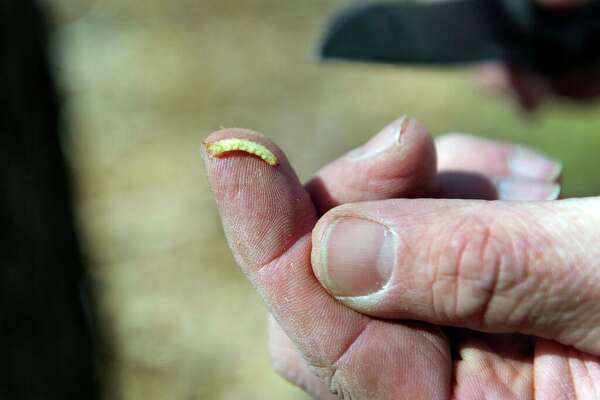
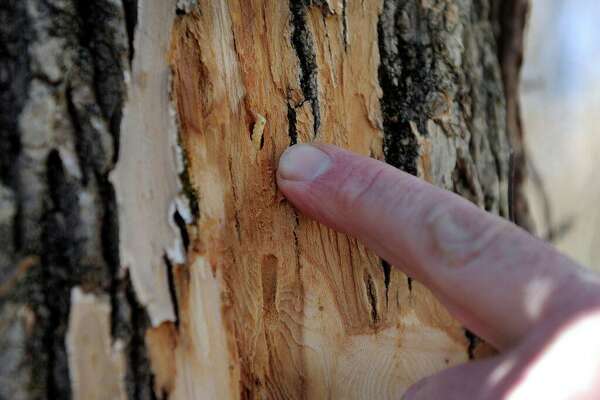
Female borers lay their eggs on ash tree bark. When the eggs hatch into larvae, the larvae bores into the tree and feeds on the inner bark and cambium — the cells between a tree’s wood and its bark — cutting channels into the tree. Those channels girdle a tree, preventing water and nutrients to reach its branches. The infestation can kill a tree within two years.

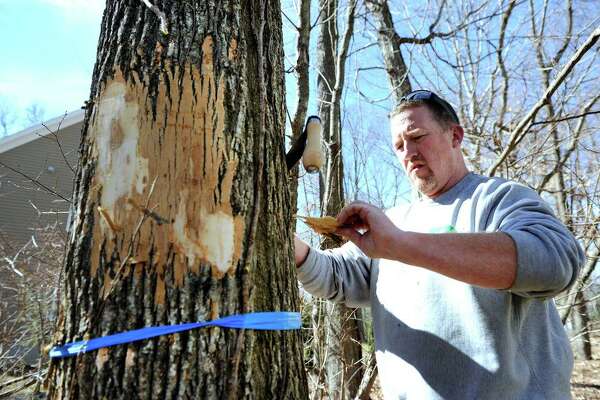
Woodpeckers then show up to peel away the infested tree’s bark to feed on the larvae. When you see an ash tree with pale yellow stripes and blotches, you know woodpeckers have been at work and that the tree is a goner.

The agricultural experiment station’s researchers found the shiny green beetles in New Haven County, Connecticut in 2012. By now, they’ve spread across the entire state.

“Pretty much every ash tree is gone — 95 to 98 percent are dying,” said Michael McCarthy, Newtown’s tree warden.

“It’s out of control,” said Michel Boucher, New Milford’s tree warden. His town has removed 400 dead ash trees along town roads in the past year, he said.

“They’re all shot,” said Kevin Lindquist, owner of Danbury Tree Pro.

Because ash trees thrive in open spaces, they grow well along roadsides. The cost to towns of cutting down all those dying ashes is another form of emerald ash borer damage - this time to town budgets.

“It will be horrendous,” Newtown’s McCarthy said.

Matt Bartelme, owner of Bart’s Tree Service in Danbury, said that because the emerald ash borer doesn’t spread rapidly on its own — humans moving beetle-infested firewood are its chief means of transport — you can find the occasional healthy ash tree in the woods.

“It’s as if it’s in its own little quarantine,” he said.

Bartelme also said you can track the infestation in the state year by year. Right now, he said, there are still healthy ash trees in coastal towns like Westport and Darien — the borer simply hasn’t spread there yet.

Rutledge, of the experiment station, said that young ash trees’ need for open air and sun may pay off in the future. When big infested, diseased ash trees fall, she said, that will create a hole in the forest canopy, allowing seedlings or trunk sprouts to thrive.

“They’re pretty good truck sprouters,” she said.

Throw in parasitic wasps and there may be hope for an ash tree comeback.

“It’s my prediction,” Rutledge said. “I think there’s a chance for ash trees.”

Contact Robert Miller at earthmattersrgm@gmail.com

Robert Miller has been working as a reporter in western Connecticut since 1978. He has covered the environment for about half that time. In 2014, he retired from day-to-day reporting, but has continued to write a weekly column on the environment for The News-Times in Danbury. He's a birder and a gardener and a bookworm who lives in the exurbs - the rural suburbs. He thinks the world we live in -- even his tiny corner -- is an endlessly fascinating place and he has been very lucky to write about it.


Wednesday, October 21, 2020

RecPath Topping at Lane St

Bill Dyer from the Trails Committee was out with Dan and Dave Landscaping today putting a fresh topping layer on the RecPath at Lane St and Wesley Drive.

That portion of the Shelton Lakes Recreation Path provided a temporary detour when the Lane Street Bridge was replaced.  When the temporary paving was removed earlier this year, the underlying crushed stone was firm, but too coarse for bicycle and other traffic.  Dan and Dave placed a 10 foot wide swath of crushed stone that is smaller than 3/8's of an inch in diameter to be a finer surface course for the RecPath.


This was about 450 linear feet of RecPath along the Lane St. Fire Access Drive.  The finished section ties back into the RecPath by the stone wall.


The fine surface layer is a little soft now, but a lot of people were still using it today.  The Shelton Highways and Bridges Department will come out and roll the fine stone with one of their rollers in the near future.  The resulting path will be smoother and easier for all users; including bikes, baby strollers and wheelchairs.  Wood chips may be placed along the sides.

It was a very pretty early Fall picture along that portion of the Recreation Path.

That portion of the RecPath also includes Shelton's Famous Chestnut Tree that you may have seen in the papers recently.

Thanks to the Shelton Conservation Commission for authorizing these improvements, Dan & Dave for doing a nice job, and Bill Dyer for organizing everything.


Saturday, October 22, 2016

A Rainy Fall Walk along the RecPath

A series of rain storms helped cancel Saturday's work party, but a break in the cloud warrented a hike on the RecPath.  Got to finish the Shelton Trails Challenge.

I started today's walk in late afternoon, at the lower Wesley Drive crossing.

It was a moody, grey day, but you can see some things if you pay attention to the leaves around you.

The RecPath at the Lane St. Fire Access road had a variety of Tulip, beech, maple, and some other funny leaf.

A really long, sharp- toothed American Chestnut leaf.  It's very distinctive along the RecPath, once you start to look for it.

Other things started to jump out in the grey light, like this Mockernut Hickory.

The RecPath curved in and around trees, dipped into channel, over bridges, with some nice overlooks of Basil Brook.

There was some Witch Hazel in flower near the upper Wesley Drive crossing.  One of the only shrubs to flower in the Fall.  This one's yellow leaves were gone, but the flower's were still there.  Witch Hazel bark and roots are used as a medicinal astringent for a variety of medical treatments.

There was more Witch Hazel near Great Ledge and Oak Valley Road further up the RecPath.  It really stands out this time of year if you know what to look for.

There was also a lot of deep red - purple Maple Leafed Viburnum along the Path.  There were still a few of the purple berries left that the birds had missed so far.

Sadly, some of the ash trees above Lizard Head Rock and Crabapple Drive were dying.  You could see the dead tops and then looking lower you could see the distinctive bark.

The bark is gone from "blonding"; the loss of the bark from woodpeckers searching for bugs in the dying trees.


So whether its from Emerald Ash Borers, some fungus, or some other blight we are losing a lot of our ash trees almost overnight.

When you've seen one you start looking along along the Path and you'll see a number of sick ash trees that are under attack.

But then you come to other old friend, like the knobby maple tree,
near the turtle pond and they seem to be doing OK.


This Red Maple has been around for a while and has the bumps and lumps to prove it, but it keeps going on and is in a scenic spot near the gas pipeline crossing.

There are some surprisingly picturesque spots when you come out onto the powerlines.  There is a very colorful shrub community that grows under full sunlight without the shadowing of tress along the powerlines.

The RecPath winds through wetlands along Spooner Swamp and around the power towers near Great Ledge.

All that left of the Sweet Pepperbush are the little pepper seeds.

On the other hand the Winterberry looks like it will have a bumper year and the leaves are still all green along Spooner Swamp.

Further up, the oaks start to take over near appropriately enough Oak Valley Lane.


The RecPath winds along as it crosses a couple of driveways and parallels Oak Valley Road before heading North toward the Dog Park.  It was a pretty walk that demonstrated that even on a rainy grey day there were new things to see.  You just have to look around you and ask yourself what am I  looking at?  Fall is a time of change, but it won't last forever.  Try to find the time to enjoy it.


Sunday, September 11, 2016

A Rare Chestnut Surviving in Shelton

Near the end of this weekend's work party along the RecPath we were talking to one of the neighbors and spotted these funny looking seed pods along the Path.

It wasn't a walnut, or a hickory nut, or an orange osage.  So we all started looking at the surrounding trees a little closer and saw this.

A Chestnut Tree!  They can be identified by their long, lance-shaped leaves with the doubly sharp tips and pointed ends.  Normally these a smaller shrubs mixed in with larger beech, birch, hickory, oak and maple trees.  They normally don't get to be tree-sized because they are attacked by a blight destroys their bark and kills the tree.  The sapplings keep re-sprouting from the old roots.


There was a 6" diameter American Chestnut growing along the side of the RecPath in the City R.O.W. that was about 30' tall and was dropping the nuts.  The bark was smooth and grey, like a beech tree, but there was no sign of fissures or blight in the bark.  Normally the blight hits the sapplings way before they get this big and start producing nuts. 


The area had been disturbed about 20 years ago when Blakeman Construction built the fire access road to Lane Street as part of the Huntington Woods Subdivision.  A portion of that fire road was later used for the Recreation Path.  There was no way to tell if the sappling was growing before construction or started to grow afterwards. I must have walked past this tree a couple of hundred times and not noticed it as a larger Chestnut.


These trees were wiped out in most of the East Coast in the early 1910's by an imported fungus.  The American Chestnut were massive trees and one of the most valuable trees in the forest both for its nuts and it's lumber.   Many people have been trying to restore disease-resistant hybrids for years.  The Connecticut Agricultural Experiment Station has had a cross-breeding program going on for decades.  

So maybe this is a lucky survivor that hasn't gotten the blight yet, or it's a disease resistant decedent, in which case it should be observed and protected. Lets hope it continues in good health.  Remember to look around when you're out hiking; some times it pays to see the trees that make up the forest.


Sunday, January 24, 2010

Really Big Pin Oaks

Well, we were out yesterday morning flagging & clearing the route for the Northwest Passage. It was a cold, but sunny morning that was really pleasant. We had a good turn out. In addition to our regular cast we had Janice and Dominick, along with Ryan. As Bill likes to say "Many hands makes light work".


While we were working out our plan of attack we had a number of cars slow down to look at us & one car stopped to ask what we were doing. I guess a bunch of people hanging out with loppers, machetes, saws, weed whackers, and pruners looks suspicious; it's either your friendly neighborhood trails work party, or a gang getting ready to repel a zombie attack.

The trail will follow the service road for the powerlines as it heads north.

We explored a possible route through the woods to the west of the road, but it was a sea of barberry. We would need an army of cutters to eradicate this thorny mess. Jim & I were able to wade thru with our Carhartts, but Ryan actually got a piece of his Red Sox shirt ripped off - through his hoodie. This is what happens to the forest when it is heavily browsed by deer; nothing but thorny invasive species, deer poop, and mature trees as far as the eye can see. There were not many shrubs, saplings, herbs, or native ground cover. This is not a healthy forest.
We came out onto the upper fields and followed the northern edge along the hedgerow before diving into the woods. This route should create some nice views for the finished trail.

The woods are wet and will need stepping stones to create firm footing. Luckily there are a number of suitable stones about. All we need now are some willing hands to help us move them to where they will do the most good. We picked the least wet route through the woods for the trail.

The trail is routed to pass through a grove of large Pin Oaks. These are trees typically found in floodplains and wetlands, and this group has some of the largest specimen trees that I've seen in this area. The grove is a meca for turkeys, deer & squirrels in the fall looking for acorns.

Pin Oaks are a red oak, but due to the knots left by the branches and it's tendency to check is used more for pallets and similar uses than for furniture. The branches are distinctive because the lower ones bend down, the middle branches stick out straight, and the upper branches go upward.

It was a good work party, & we got a lot done thanks to Janice, Dominick, Ryan & everybody else. There's still a lot to do however & if anybody wants to help out we've got lots of stepping stones to move, and brush to cut before this is a finished trail. See you at the next trails work party.

Make plans to come to the marshmallow roast and hike at Nicholdale on Feb. 6th. It should be a lot of fun for families and kids of all ages.